Turncarver
A Photo Journal
V2_2505151625
September 2016: Sicily
On September 19 we took a 2-week vacation in Sicily and Rome. We
opted for a flexible itinerary instead of extensively planning the trip. This worked
well because we were able to take advantage of options we discovered after arriving,
but we missed some opportunities. We heard busses and trains were inconsistent and
slow, so we opted to rent a car instead of relying on public transportation - that
turned out to be a good idea.
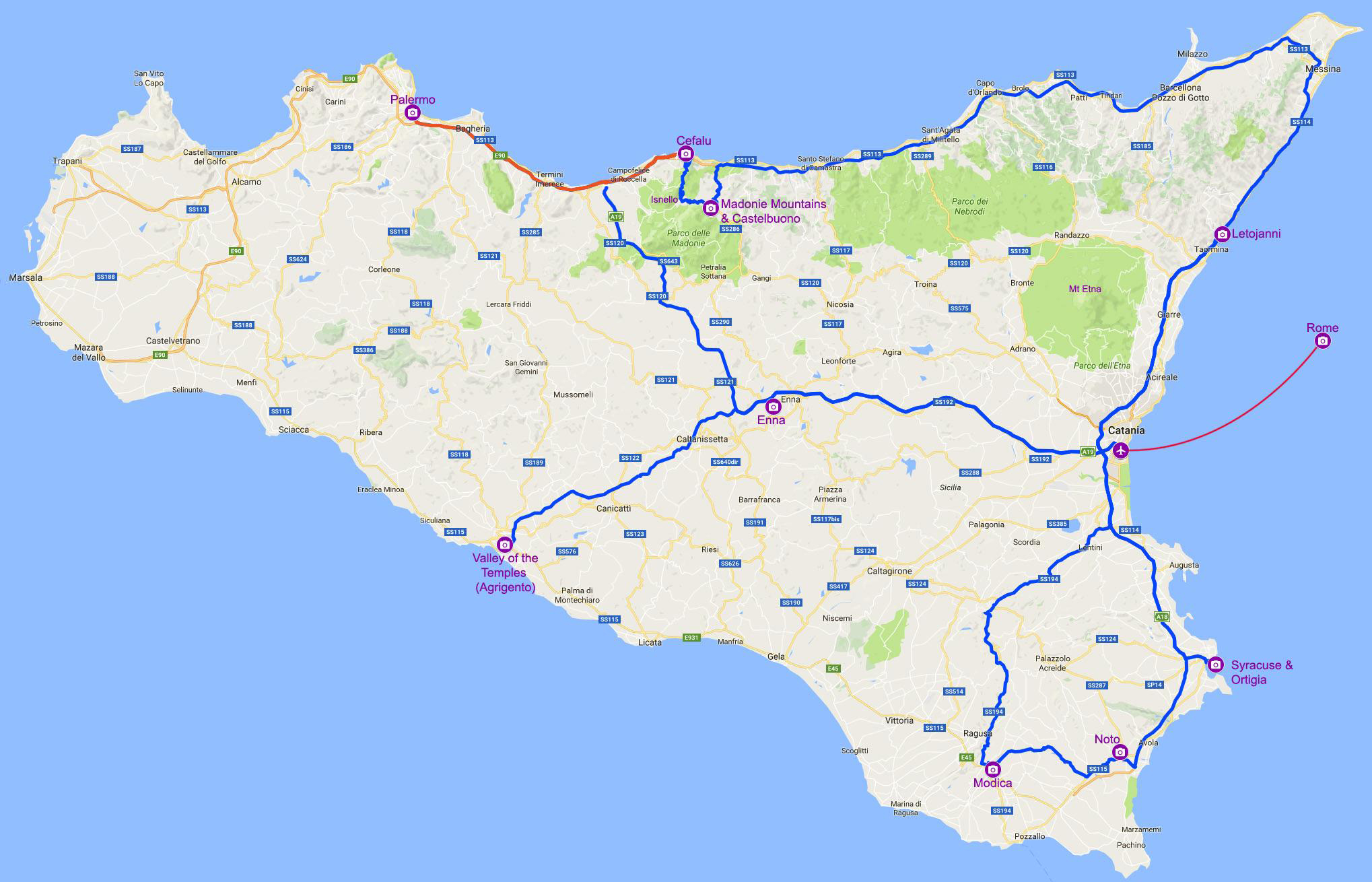
After flying into Rome and then to Catania, we drove to Cefalu via the A19 through the center
of the island. We stayed a couple of days in Cefalu on the north coast, then moved to Letojanni
(near Taormina) and made day excursions for the rest of our stay. The map at the end of this page
shows the routes we followed as we drove around the island.
- Cefalu. Cefalu is a picturesque medieval town in the shadow of a large rock (Rocca). There’s a very popular beach, lots of tourists, some good restaurants. One day is plenty of time to see the town and climb the rock, which affords some great views of Cefalu, the cathedral and the coastline.
- Palermo. We took the train from Cefalu to Palermo - it ran frequently and on schedule; the trip took about 50 minutes. Exploring the old streets of Palermo was interesting. Many sections are essentially a labyrinth of narrow streets - there’s not much danger of getting lost, but a detailed map or GPS is very helpful to find specific sites. The public markets and Cappella Palatina were highlights. And, of coarse, there were lots of churches to visit.
- Madonie Mountains. The owner of our B&B in Cefalu suggested a visit to the Madonie mountains outside Cefalu, so we took a detour on our way to Letojanni. The mountains are bigger than I expected, and the hill towns are very picturesque. We stopped in Castelbuono and visited Fiasconaro, where they have perfected a Sicilian version of panettone. This panettone is very different from the Panettone I’ve tasted before; I prefer the Sicilian variation. I purchased a cioccolato (chocolate) panettone that lasted the rest of our stay in Sicily
- Letojanni. For the remainder of our trip we stayed in Letojanni, a small beach resort town about 5KM from Taormina. While Letojanni is not as flashy as Taormina, we were able to rent an apartment with a deck overlooking the beach for a modest price. Letojanni also afforded much easier parking and in/out access by car. The primary attraction in Letojanni is the beach, but we were able to find an excellent seafood restaurant we visited twice (Ristorante Da Nino). Don’t confuse it with the Ristorante Trattoria Da Nino in Taormina, and don’t pay attention to the TripAdvisor reviews that complain about the size of the shrimp - it was excellent.
- Taormina. We spent a couple of days walking around Taormina. Its very picturesque situated on a hill above the coastline. Other than a lot of tourists and shops, the major sites are the Greek Theater and a walk up to Castelmola for almond wine at Bar San Giorgio.
- Syracuse / Ortigia. Ortigia, the medieval center of Syracuse sits on a small island connected to the modern city by a couple of bridges. We did not plan our day very well, so we missed a lot of the sights here. Its a large enough city to be worth looking into public transportation or planning to drive to some of the sights. It was also a rainy day, and (for unknown reasons) many places were closed.
- Enna. Enna is a hill town at the center of Sicily. Its a pleasant town in a picturesque setting. We enjoyed a walk around the town and had a quick lunch before heading to the Valley of the Temples.
- Valley of the Temples. The Valley of the Temples is a UNESCO heritage site near Agrigento containing many well-preserved Greek ruins. One of the ruins, the Temple of Concordia, is one of the best preserved Greek temples in the world
Modica would have been an excellent place to spend 2 or 3 nights while touring the area.
- Modica. Modica is a baroque town that straddles a small valley in southern Sicily. The lower section of the town (Modica Basso) is flanked on both sides by buildings on the hillsides. The upper town (Monica Alto) is on the southern Ibeli hill. Along with Noto, Modica is a UNESCO heritage site. It is famous for its chocolate, which made using the Aztec “cold-worked” technique. The chocolate contains nothing but ground cocoa beans, sugar, and sometimes one other ingredient (spice, herb, fruit) to add flavor. Unlike other chocolate, the mixture never goes above 40 degrees centigrade during processing, so the sugar does not melt, and remains granular. The chocolate has a deep, sweet flavor, and crumbles in the mouth.
- Noto. Noto contains many spectacular 18th century baroque buildings and churches. The old town center is small and it only takes a couple of hours to walk through it.
- Rome. After leaving Sicily, we spent a couple of days in Rome. As usual, it wasn’t enough time. We visited the Vatican Museum and Saint Peter’s Basilica (very spectacular). One of the highlights of the trip was a nighttime walk through the city.
The map below shows our driving route while in Sicily. Click on the map for a larger view.